4f0e2dde98
* feat: add Raspberry Pi Pico 2 + W5500 + E22-900M30S variant

Adds community variant for Raspberry Pi Pico 2 (RP2350, 4 MB flash)
with external WIZnet W5500 Ethernet module and EBYTE E22-900M30S LoRa
module (SX1262, 30 dBm PA, 868/915 MHz).

Key details:
- LoRa on SPI1: GP10/11/12/13 (SCK/MOSI/MISO/CS), RST=GP15,
  DIO1=GP14, BUSY=GP2, RXEN=GP3 (held HIGH via SX126X_ANT_SW)
- W5500 on SPI0: GP16/17/18/19/20 (MISO/CS/SCK/MOSI/RST)
- SX126X_DIO2_AS_RF_SWITCH: DIO2→TXEN bridge on module handles PA
- SX126X_DIO3_TCXO_VOLTAGE 1.8: TCXO support via EBYTE_E22 flags
- DHCP timeout reduced to 10 s to avoid blocking LoRa startup
- GPS on UART1/Serial2: GP8 TX, GP9 RX
- Reuses WIZNET_5500_EVB_PICO2 code paths for Ethernet init

Co-Authored-By: Claude Sonnet 4.6 <noreply@anthropic.com>

* pico2_w5500_e22: rename define and address review feedback

Rename WIZNET_5500_EVB_PICO2 to PICO2_W5500_E22 so the variant-specific
define matches the variant directory name and isn't confused with an
on-board EVB SKU.

Review fixes from PR #10135:
- Gate the 10 s Ethernet DHCP timeout behind PICO2_W5500_E22 so other
  Ethernet builds keep the default 60 s behavior; apply the same timeout
  to reconnectETH() for consistency.
- Drop the unused -D EBYTE_E22 flag; EBYTE_E22_900M30S already selects
  TX_GAIN_LORA / SX126X_MAX_POWER in src/configuration.h.
- Rewrite "on-board W5500" comments to describe the external module.
- Correct README TX_GAIN_LORA value (7, not 10) and drop the EBYTE_E22
  row.

* fix(pico2_w5500_e22): drop DEBUG_RP2040_PORT=Serial

The arduino-pico framework hooks _write() when DEBUG_RP2040_PORT=Serial
is set and dumps raw debug bytes onto USB CDC, corrupting any binary
protobuf stream sent through StreamAPI (e.g. `meshtastic --port COMx`).

The variant excludes BT and WiFi, so the primary client transport is
Ethernet TCP via ethServerAPI — unaffected — but users who configure
the node over USB serial would see protobuf decode failures from
debug-byte interleaving. Removing the flag restores clean USB CDC.

Debug output can still be enabled per-build by adding -D DEBUG_RP2040_PORT=Serial1
to redirect to UART0 instead of USB CDC.

* feat: add Ethernet OTA support for RP2350/W5500 boards

Adds over-the-air firmware update capability for RP2350-based boards
with a WIZnet W5500 Ethernet module (e.g. pico2_w5500_e22).

Protocol (MOTA):
- SHA256 challenge-response authentication with a configurable PSK
  (override via USERPREFS_OTA_PSK; default key ships in source)
- 12-byte header: magic "MOTA" + firmware size + CRC32
- Firmware received in 1 KB chunks, verified with CRC32, written via
  Updater (picoOTA), then device reboots to apply
- Constant-time hash comparison prevents timing attacks on auth
- 30s inactivity timeout + 5s cooldown after failed auth
- Response codes 0x00-0x08 map 1:1 to OTAResponse enum

Firmware side:
- ethOTA.cpp / ethOTA.h: OTA TCP server on port 4243
- ethClient.cpp: wire initEthOTA/ethOTALoop into reconnect loop
- main-rp2xx0.cpp: hardware watchdog (8s, paused during debug)
- pico2_w5500_e22/platformio.ini: HAS_ETHERNET_OTA flag,
  filesystem_size bumped to 0.75m for OTA staging

Host side:
- bin/eth-ota-upload.py: Python uploader with progress and full
  result-code mapping (matches OTAResponse 0x00-0x08)

* style(eth): clang-format ethOTA.cpp per repo .clang-format

Reformat to the repo trunk clang-format config (IndentWidth 4,
ColumnLimit 130). Resolves the Trunk Check 'Incorrect formatting'
failure on PR #10136.

Co-Authored-By: Claude Opus 4.8 (1M context) <noreply@anthropic.com>

---------

Co-authored-by: Claude Sonnet 4.6 <noreply@anthropic.com>

Meshtastic Firmware




Overview
This repository contains the official device firmware for Meshtastic, an open-source LoRa mesh networking project designed for long-range, low-power communication without relying on internet or cellular infrastructure. The firmware supports various hardware platforms, including ESP32, nRF52, RP2040/RP2350, and Linux-based devices.
Meshtastic enables text messaging, location sharing, and telemetry over a decentralized mesh network, making it ideal for outdoor adventures, emergency preparedness, and remote operations.
Get Started
- 🔧 Building Instructions – Learn how to compile the firmware from source.
- ⚡ Flashing Instructions – Install or update the firmware on your device.
Join our community and help improve Meshtastic! 🚀
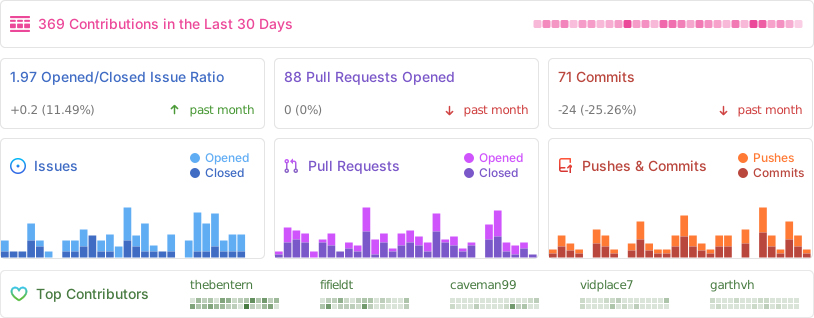
Stats