Ben MeadorsandGitHub
0e84c1a827
Ben MeadorsandGitHub
0e84c1a827
Audit of the XEdDSA packet-signing implementation (#10478) surfaced several
issues in when unsigned packets are accepted on receive or emitted on send.
This fixes them and adds regression coverage.

- Unicast NodeInfo exchange no longer breaks against signer nodes: the
  NodeInfoModule downgrade drop is gated to broadcasts, since senders never
  sign unicast (want_response replies, directed exchanges).
- Replace the payload-size sign heuristic with an exact encoded-size gate
  (signedDataFits) and mirror it on the receive side, removing a dead band
  where 167-168 B broadcasts were signed then failed TOO_LARGE.
- Extract the receive policy into checkXeddsaReceivePolicy() and apply it to
  plaintext-MQTT decoded downlink, which previously skipped signature
  verification and downgrade protection entirely.
- Reject signatures whose length is neither 0 nor 64 as malformed, so a
  crafted partial signature can't inflate the size estimate and dodge the
  unsigned-downgrade drop.
- Hold cryptLock on the MQTT verify path (shared Ed25519 key cache).
- Clear any client-preset signature on packets we originate, on all builds.
- Randomized (hedged) signing per the Signal XEdDSA spec: bump the
  meshtastic/Crypto pin to the build where XEdDSA::sign mixes 32 bytes of
  caller randomness into the nonce as Z (meshtastic/Crypto#3), and seed those
  bytes in xeddsa_sign from HardwareRNG (checked, with a seeded-CSPRNG
  fallback). test_crypto pins that repeated signs differ and both verify.

Adds test coverage: test_packet_signing groups A-E (receive matrix, send
policy, NodeInfo backstop, encoding invariants, decoded-ingress policy),
test_mqtt end-to-end downlink cases, and a test_crypto randomization check.

Meshtastic Firmware




Overview
This repository contains the official device firmware for Meshtastic, an open-source LoRa mesh networking project designed for long-range, low-power communication without relying on internet or cellular infrastructure. The firmware supports various hardware platforms, including ESP32, nRF52, RP2040/RP2350, and Linux-based devices.
Meshtastic enables text messaging, location sharing, and telemetry over a decentralized mesh network, making it ideal for outdoor adventures, emergency preparedness, and remote operations.
Get Started
- 🔧 Building Instructions - Learn how to compile the firmware from source.
- ⚡ Flashing Instructions - Install or update the firmware on your device.
Join our community and help improve Meshtastic! 🚀
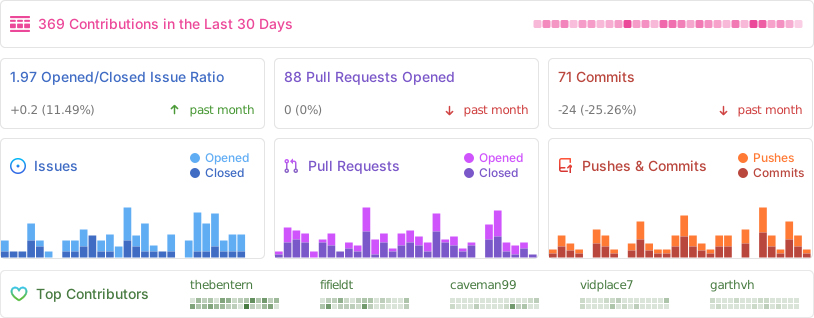
Stats