45cb8e7500
* feat: isolate event radio profiles

* fix: preserve identity on degraded config boot

* fix: guard event profile storage

* style: align event profile storage names

* fix: discard event profile on normal boot

* refactor: simplify event profile cleanup

* fix: limit inactive profile migration to event firmware

* fix(event): make event-profile capacity check portable across filesystems

The USERPREFS_EVENT_MODE storage preflight called FSCom.totalBytes() and
FSCom.usedBytes(), which only exist on ESP32's LittleFS wrapper. Every other
backend failed to compile once event mode was enabled:

  error: 'class InternalFileSystem' has no member named 'totalBytes'   (nRF52)
  error: no member named 'totalBytes' in 'fs::FS'                      (Portduino)

This was not caught earlier because the event block is behind
#if USERPREFS_EVENT_MODE, and the existing unit tests only cover the pure
helpers, which compile identically either way.

Add fsTotalBytes()/fsUsedBytes() to FSCommon and implement them per backend:
littlefs v1 traversal for nRF52 (Adafruit_LittleFS) and STM32
(STM32_LittleFS), FSInfo for RP2040, statvfs for Portduino, and the native
methods for ESP32 and nRF54L15. The nRF52/STM32 path reports "full" if the
traversal errors so the capacity check fails safe.

Verified with USERPREFS_EVENT_MODE=1: native-macos test_event_profile_storage
passes 5/5, and heltec-v3, rak4631, rak11310 and rak3172 all build clean.

* fix(event): use std::filesystem for Portduino capacity, bump native-suite-count

Two CI fixes:

- native-windows has no <sys/statvfs.h>, so the Portduino branch of
  fsTotalBytes()/fsUsedBytes() broke the Windows build. Switch to
  std::filesystem::space(), which is already used under ARCH_PORTDUINO in
  HostMetrics.cpp and works on both POSIX and MinGW. Errors report "full"
  so the capacity check still fails safe.

- This PR adds test/test_event_profile_storage, taking test/ from 40 to 41
  suite directories, which trips the native-suite-count reconciliation check.

* fix(event): scope boot-write deferral to the radio profile, address review

Review feedback:

- Copilot: saveProto()'s boot-write deferral applied to every file, so
  loadFromDisk()'s recovery writes (e.g. restoring owner fields into
  devicestate) were silently dropped and never retried, because the ctor CRC
  baselines are computed after loadFromDisk(). Deferral now applies only to
  the radio-profile files, via isRadioProfileFile().

- jp-bennett: eventConfigFromStandard() wrapped a struct copy plus one field
  assignment in a header helper with its own unit test. Inlined at its single
  call site and removed; the behaviour is covered end-to-end by hardware
  validation instead (RAK4631 normal -> event -> normal preserves NodeNum and
  public key while swapping LoRa, and restores the original channel
  byte-identically).

- jp-bennett: the active-backup encrypted-storage migration ran for normal
  builds too, which changed non-event behaviour and contradicted the PR's
  stated event-only scope. Scoped to USERPREFS_EVENT_MODE; the adjacent block
  already covers the inactive standard backup in event builds.

New tests (all verified to fail under mutation, not vacuous):

- test_event_paths_never_collide_with_standard_or_shared_files: the core
  safety property. A path-table slip would make event firmware overwrite the
  user's real config, channels or backup, or capture a shared file like
  devicestate/nodedb. Nothing asserted this before.

- test_only_radio_profile_files_defer_boot_writes: guards the deferral fix
  above so re-widening it fails loudly.

- test_event_reservation_fits_smallest_supported_filesystem: the reservation
  is compile-time but must fit filesystems as small as 14 KiB (STM32WL) and
  28 KiB (nRF52840). Protobuf growth pushing it past those would silently
  stop event profiles persisting - the exact failure mode confirmed by
  fault injection on a RAK4631.

Verified with USERPREFS_EVENT_MODE both on and off: 7/7 tests pass, and
rak4631, heltec-v3, rak11310 and rak3172 all build clean.

* fix: preserve event profile storage recovery

---------

Co-authored-by: Jonathan Bennett <jbennett@incomsystems.biz>
Co-authored-by: Ben Meadors <benmmeadors@gmail.com>
Co-authored-by: Benjamin Faershtein <benjaminfaershtein@Benjamins-MacBook-Pro-2.local>

Meshtastic Firmware




Overview
This repository contains the official device firmware for Meshtastic, an open-source LoRa mesh networking project designed for long-range, low-power communication without relying on internet or cellular infrastructure. The firmware supports various hardware platforms, including ESP32, nRF52, RP2040/RP2350, and Linux-based devices.
Meshtastic enables text messaging, location sharing, and telemetry over a decentralized mesh network, making it ideal for outdoor adventures, emergency preparedness, and remote operations.
Get Started
- 🔧 Building Instructions - Learn how to compile the firmware from source.
- ⚡ Flashing Instructions - Install or update the firmware on your device.
Join our community and help improve Meshtastic! 🚀
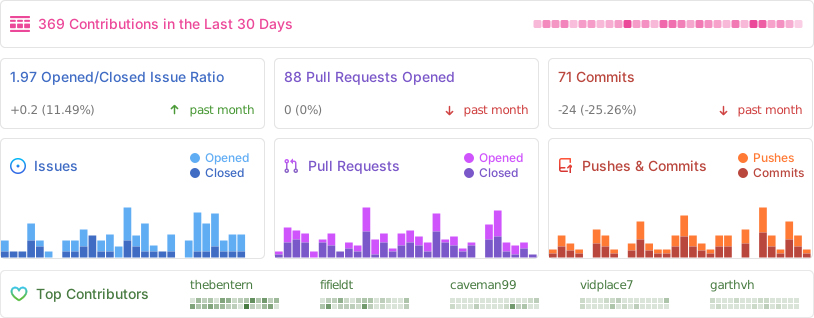
Stats