Ben Meadors
5cf85d523a
Ben Meadors
5cf85d523a
* fix(display): don't leak a TFT driver instance on every screen wake

On variants whose Screen::handleSetOn() re-runs ui->init() on each display
wake (Heltec Tracker V1.x/V2, VTFT_LEDA and ST7796 boards, MUZI/Cardputer
via dispdev->init()), OLEDDisplay::init() unconditionally re-invokes
connect(), and TFTDisplay::connect() allocated a fresh driver instance
each time without freeing the old one. Each OFF->ON transition orphaned a
full LGFX device (measured: exactly 1,260 bytes per wake on a Heltec
Wireless Tracker V2). Since PowerFSM wakes the screen on every received
text message, a device on a busy channel leaked tens of KB per day -
matching field reports of heap climbing from 78% to 92% within a day.

Null-guard the driver allocations (matching the existing linePixelBuffer/
repaintChunkBuffer guards below them) so re-entry re-runs tft->init() on
the existing instance. Bench-validated on a Tracker V2: free heap now flat
across 13 consecutive wake cycles, with the panel still re-initializing
and rendering on every wake.

* fix(ble): don't leak BluetoothPhoneAPI and callbacks on BLE re-enable

NimbleBluetooth::setup()/setupService() re-run when Bluetooth is
re-enabled after deinit(), but BLEDevice::deinit() only frees the GATT
objects - the caller-owned allocations were re-created unguarded on every
cycle:

- bluetoothPhoneAPI: ~3.5KB PhoneAPI object per cycle, and the orphaned
  instance is an OSThread that stays registered with the scheduler, so a
  duplicate thread kept servicing the same static queues
- toRadioCallbacks / fromRadioCallbacks / security + server callbacks:
  one small object each per cycle
- the BLESecurity shim was heap-allocated and never freed even on first
  boot; it only forwards to static setters, so use a stack instance

Reuse the existing objects on re-setup; the setCallbacks() calls still
run every time since the characteristics themselves are new.

* chore: remove unused PacketCache

PacketCache landed in #8341 but no consumer was ever wired up - repo-wide,
the only references to PacketCache/packetCache are in its own two files.
As designed it also malloc()s per cached packet with no eviction or size
cap, so it should be re-reviewed for bounds before any future use. Remove
the dead code; git history preserves it if a bounded revival is wanted.

* fix(ble): reset stale session state when reusing BluetoothPhoneAPI

Review follow-up: reusing bluetoothPhoneAPI across BLE enable cycles could
hand the next session the previous session's dirty state. The only full
cleanup path (onDisconnect) is skipped when deinit()'s bounded disconnect
wait expires before the event lands (its 2s cap matches the connection
supervision timeout, so a phone that walked out of range makes this a
coin flip): the reused object then enters the next session mid-config,
with stale queue contents served to the new phone and a stale connection
handle that defeats the checkConnectionTimeout self-heal.

Factor onDisconnect's cleanup into resetBleSessionState() and run it from
setupService() when reusing the instance, restoring the old fresh-object
invariant. Also switch the four stateless callback objects to function-
local statics (the resolved framework BLE wrapper stores plain pointers
and never frees them, so static instances are safe and avoid the guarded
heap allocations), correct the comment that claimed deinit() frees the
GATT objects (it deletes only the BLEServer itself; the services and
characteristics it created remain a small library-side leak per cycle),
and fix the inverted connection check in getRssi() that made BLE RSSI
always read 0 on ESP32-S3/C6.

* refactor(display): construct-once guard around the whole driver ladder

Review follow-up: one if (!tft) around the #if/#elif/#else construction
block instead of a guard per branch, so a future display family can't
reintroduce the per-wake leak by copying an unguarded branch. Make the
HACKADAY bus pointer local to the construction (it was a write-only
global), and point the comment at the Screen::handleSetOn gates instead
of hand-listing boards that would go stale.

* fix(ble): use-after-free notifying a freed characteristic after deinit()

deinit() nulled bleServer and BatteryCharacteristic but left
fromNumCharacteristic dangling after BLEDevice::deinit(true) freed the
GATT graph, and it never detached the PhoneAPI fromNumChanged observer.
When deinit()'s bounded 2s disconnect wait expires before onDisconnect
runs (the same stale-bond / host-reset race resetBleSessionState was
built for), close() is skipped, so the observer stays attached with
state == STATE_SEND_PACKETS. After BLE is off, the next mesh packet
drives MeshService fromNumChanged -> PhoneAPI::onNotify -> onNowHasData
-> fromNumCharacteristic->notify() on freed memory (the framework BLE
wrapper's notify() dereferences the freed server via getConnectedCount).
Unlike sendLog(), onNowHasData() had no isConnected guard.

deinit() now calls resetBleSessionState() to detach the observer and
reset session state unconditionally (also forcing the conn handle to
NONE so checkConnectionTimeout can't be fooled by the stale handle),
nulls fromNumCharacteristic/logRadioCharacteristic like the other freed
pointers, and onNowHasData() bails on a null characteristic.

Reachable on all ESP32/S3/C6 NimBLE boards via admin disable-bluetooth
or a sleep transition while a phone is connected. Found by a follow-up
lifecycle audit of the re-enable changes in this PR.

Meshtastic Firmware




Overview
This repository contains the official device firmware for Meshtastic, an open-source LoRa mesh networking project designed for long-range, low-power communication without relying on internet or cellular infrastructure. The firmware supports various hardware platforms, including ESP32, nRF52, RP2040/RP2350, and Linux-based devices.
Meshtastic enables text messaging, location sharing, and telemetry over a decentralized mesh network, making it ideal for outdoor adventures, emergency preparedness, and remote operations.
Get Started
- 🔧 Building Instructions - Learn how to compile the firmware from source.
- ⚡ Flashing Instructions - Install or update the firmware on your device.
Join our community and help improve Meshtastic! 🚀
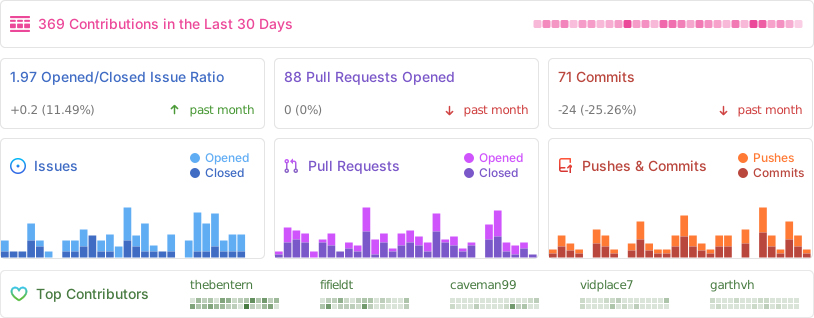
Stats