Ixitxachitl
8fe246e250
Ixitxachitl
8fe246e250
* fix(mesh): relay foreign packets whose channel hash collides with a local channel

The channel hash is one byte, so a foreign channel's name/PSK can fold to the
same hash as a local channel (~1/256 per local channel held). Since d6b12ea3f,
perhapsDecode returns DECODE_FAILURE whenever any local channel matched the
hash, and passesRoutingAuthGate turned that into REJECT - silently blackholing
legitimate foreign traffic that master and 2.7.x relay. A node with a wrong PSK
for a channel name stopped relaying the real channel entirely.

Channel crypto (AES-CTR) has no authentication tag, so "wrong key, foreign
channel" and "our channel, tampered payload" are indistinguishable at this
decision point. The strict drop bought nothing: an attacker picks a hash
matching no local channel and gets DECODE_OPAQUE relay anyway (test_C6), so
the rule only suppressed honest colliding traffic.

Return OPAQUE_RELAY_ONLY on DECODE_FAILURE unless the packet is addressed to
us or claims to be from us. isFromUs stays REJECT because OPAQUE_RELAY_ONLY
reaches perhapsGenerateImplicitAckForOwnOverheard, which matches pending sends
on header bytes alone - a forged sender with a colliding hash and matching id
could otherwise fake-ACK a DM and cancel its retransmissions. Other
DECODE_FAILURE sources are unaffected: legacy-DM rejection, pending-key
refusal, and failed PKI candidates are all isToUs, and the KNOWN_ONLY early
return is re-gated by relayOpaquePacket's own mode check. Opaque frames still
never touch PacketHistory, NodeDB, modules, MQTT, ACKs, or the phone.

test_C12's collision leg now expects OPAQUE_RELAY_ONLY (its tampered packet is
a broadcast - byte-identical to the foreign case); it still pins per-exact-byte
cache reevaluation. test_C9 renamed to match what it now verifies. New test_C17
covers the colliding-hash foreign broadcast and the spoofed-sender REJECT.

* style(mesh): trim collision-relay comment to two lines

Meshtastic Firmware




Overview
This repository contains the official device firmware for Meshtastic, an open-source LoRa mesh networking project designed for long-range, low-power communication without relying on internet or cellular infrastructure. The firmware supports various hardware platforms, including ESP32, nRF52, RP2040/RP2350, and Linux-based devices.
Meshtastic enables text messaging, location sharing, and telemetry over a decentralized mesh network, making it ideal for outdoor adventures, emergency preparedness, and remote operations.
Get Started
- 🔧 Building Instructions - Learn how to compile the firmware from source.
- ⚡ Flashing Instructions - Install or update the firmware on your device.
Join our community and help improve Meshtastic! 🚀
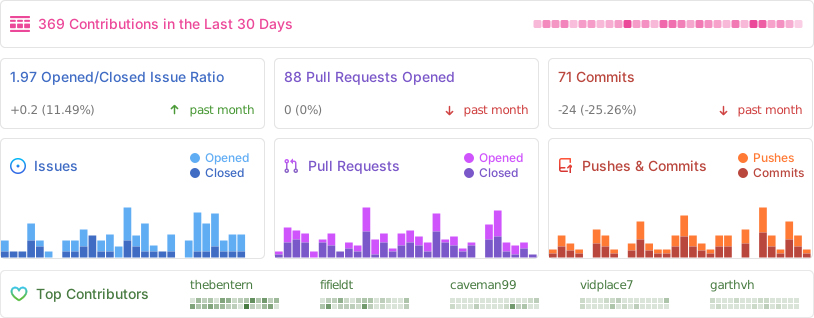
Stats