Thomas Göttgens
98813fe79d
Thomas Göttgens
98813fe79d
* Add shared e-ink hardware layer (graphics/eink) alongside legacy drivers

Foundation for a target-by-target migration off the GxEPD2-based
EInkDisplay2/EInkDynamicDisplay/EInkParallelDisplay stack:

- src/graphics/eink/: chipset drivers, panel profiles, backlight helper
  (promoted from the InkHUD driver set, shared by BaseUI and InkHUD)
- src/graphics/BaseUIEInkDisplay: OLEDDisplay adapter driving the new
  layer, with EINK_* compat macros matching EInkDynamicDisplay
- [niche] build helper in platformio.ini; graphics/eink/ excluded from
  arduino_base so unconverted targets are unaffected
- Screen/CannedMessageModule dispatch between the two stacks per env
- InkHUD-specific touch code in TouchScreenImpl1 guarded with
  MESHTASTIC_INCLUDE_INKHUD (no-op today, required once BaseUI variants
  define MESHTASTIC_INCLUDE_NICHE_GRAPHICS without InkHUD)

No variant is converted and no legacy file is removed; every existing
env builds identical firmware.

* Fix clang-format comment alignment in Screen.cpp

* Address review findings in the e-ink driver layer

- Screen.cpp: exclude InkHUD builds from all NicheGraphics BaseUI guards
- BaseUIEInkDisplay: size the OLEDDisplay buffer from its actual indexing
- EInkParallel: defer update() while an async refresh is in flight, honor
  the selected clear mode in the async task, never delete a live task
- ED047TC1: clean up on failed initPanel, fix inverted bbepI2CWrite checks
- UC8175: drop bogus 0x12 soft reset (0x12 is display refresh on UC8175)
- LCMEN2R13EFC1: guard absent reset pin, bound the busy wait
- SSD16XX/SSD1682: build the RAM window from the instance, not statics
- Doc corrections in driver banners and Drivers/README

* SSD16XX/SSD1682: send inclusive Y-end address (height - 1)

* LCMEN213EFC1: adopt the shared wait timeout / fail-through pattern

wait() now bounds the busy poll via Throttle and sets the EInk failed
flag on timeout; sendCommand/sendData fail through like the SSD16XX and
UC8175 drivers. EInk::runOnce clears the flag after the failed cycle.

Meshtastic Firmware




Overview
This repository contains the official device firmware for Meshtastic, an open-source LoRa mesh networking project designed for long-range, low-power communication without relying on internet or cellular infrastructure. The firmware supports various hardware platforms, including ESP32, nRF52, RP2040/RP2350, and Linux-based devices.
Meshtastic enables text messaging, location sharing, and telemetry over a decentralized mesh network, making it ideal for outdoor adventures, emergency preparedness, and remote operations.
Get Started
- 🔧 Building Instructions - Learn how to compile the firmware from source.
- ⚡ Flashing Instructions - Install or update the firmware on your device.
Join our community and help improve Meshtastic! 🚀
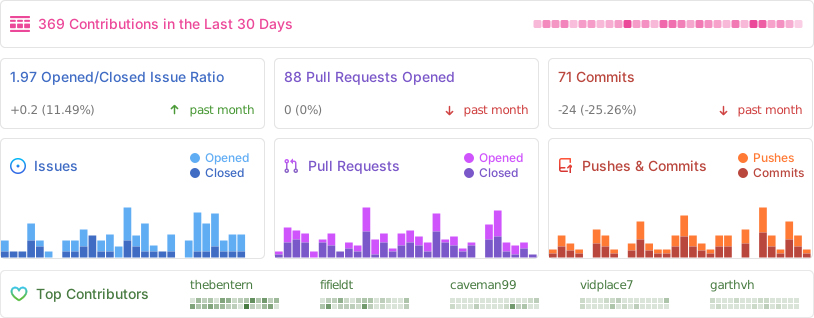
Stats