Ben MeadorsandGitHub
b4b1ece8f1
Ben MeadorsandGitHub
b4b1ece8f1
The Arduino loop task runs Meshtastic's entire cooperative OSThread
scheduler on the Adafruit core's stock 4 KB (1024-word) stack. The 2.8
first-sync path - AdminModule::handleSetConfig -> saveChanges ->
configChanged -> RadioInterface::reloadConfig -> LR11x0 reconfigure ->
SPI Lock::lock, with vsnprintf/USB-CDC logging frames stacked on top -
overflows it.

SWD fault capture on a T1000-E (pyocd vector_catch=h) proved it: the
loop task's SP was driven 40 bytes BELOW its own pxStack base, the
stack paint was consumed to the floor, and the crash was a BusFault in
xQueueSemaphoreTake dereferencing a semaphore handle that adjacent-heap
corruption had overwritten with log text (0x3f3f207c = "| ??"). The
core's HardFault handler is a bare NVIC_SystemReset, so in the field
this presents as a silent reboot ~seconds after a phone pairs (or a 30 s
zombie hang -> supervision timeout 0x8 when the corruption lands on task
TCBs instead). Also explains the set_time_only -> immediate-NodeInfo
crash variant reported on empty-DB nodes: same task, different deep
chain. 2.7.26 is unaffected because the deep frames (XEdDSA, satellite
map conversion, replay engine) did not exist.

Fix: set -DLOOP_STACK_SZ=2048 (words = 8 KB) for all nrf52840 targets.
Requires the #ifndef guard from meshtastic/Adafruit_nRF52_Arduino#7;
until that merges the flag is a harmless redefinition warning. Validated
on hardware: pairing + full sync completes, stack paint shows healthy
margin under load.

Also fix the boot-time reset-reason log: the core's init() caches
RESETREAS and W1C-clears the register before setup() runs, so the raw
read here has always printed 0. Use readResetReason() instead.
(preFSBegin's RESETREAS==0 gate is intentionally left as-is - its
degenerate GPREGRET-only behavior is what makes lfs recovery work.)

Meshtastic Firmware




Overview
This repository contains the official device firmware for Meshtastic, an open-source LoRa mesh networking project designed for long-range, low-power communication without relying on internet or cellular infrastructure. The firmware supports various hardware platforms, including ESP32, nRF52, RP2040/RP2350, and Linux-based devices.
Meshtastic enables text messaging, location sharing, and telemetry over a decentralized mesh network, making it ideal for outdoor adventures, emergency preparedness, and remote operations.
Get Started
- 🔧 Building Instructions - Learn how to compile the firmware from source.
- ⚡ Flashing Instructions - Install or update the firmware on your device.
Join our community and help improve Meshtastic! 🚀
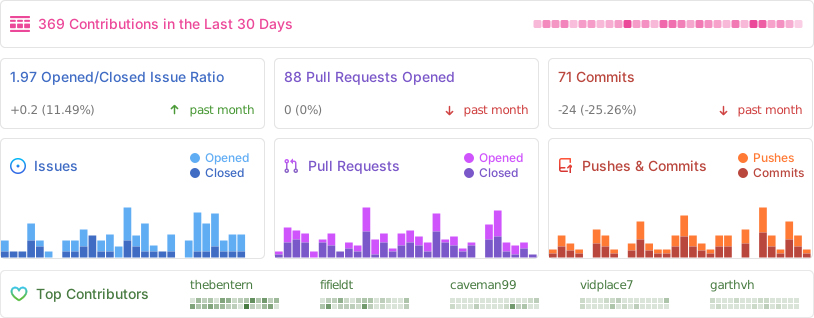
Stats