Andrew YongandBen Meadors
b71c1adb26
Andrew YongandBen Meadors
b71c1adb26
* stm32wl: add hardware RTC support infrastructure

Wires the STM32WL chip's internal RTC (running off the LSE 32.768kHz
crystal) into meshtastic's existing time-of-day framework
(perhapsSetRTC()/readFromRTC()), following the same pattern already
used for I2C RTC chips (RV3028, PCF8563/85063, RX8130CE).

LSE is started and polled manually before ever calling into the
STM32RTC library, with our own bounded timeout - the library's own
internal LSE startup path has no bounded fallback and hangs forever
via Error_Handler() if the crystal never locks, so this is required
for a board with a missing/faulty crystal to boot normally rather
than hang.

Gated behind a new HAS_LSE variant flag (currently unset everywhere,
so this is inert until a variant opts in - see follow-up commit).

Signed-off-by: Andrew Yong <me@ndoo.sg>
Assisted-by: Claude Sonnet 5 <noreply@anthropic.com>

* gps: qualify RTC.h includes to avoid case-insensitive filesystem collision with STM32RTC

The stm32duino STM32RTC library (added to lib_deps in a follow-up
commit) ships its own src/rtc.h. On case-insensitive filesystems
(the macOS default), an unqualified #include "RTC.h"/<RTC.h> from
any file outside src/gps/ resolves to the library's rtc.h instead of
src/gps/RTC.h, since PlatformIO's LDF puts lib_deps include paths
ahead of the project's own -Isrc/gps.

Qualify every include as gps/RTC.h so it can't collide with any
same-named header a future dependency might ship, regardless of
filesystem case sensitivity. Purely mechanical, no behavior change.

Signed-off-by: Andrew Yong <me@ndoo.sg>
Assisted-by: Claude Sonnet 5 <noreply@anthropic.com>

* stm32wl(rak3172): enable hardware RTC support

Opts rak3172 into the HAS_LSE infrastructure added previously: sets
STM32WL_LSE_DRIVE to a conservative default and pulls in the
STM32RTC library. rak3172 has ~63KB flash headroom going in;
build-verified at 76.7% flash usage after this change (up from a
73.8% baseline), well within budget.

wio-e5 is not opted in here despite sharing the same STM32WLE5 chip
- it's already at 96.8% flash usage today (GPS + I2C sensor support
compiled in, unlike rak3172), leaving too little headroom to safely
add STM32RTC without first trimming something else.

Signed-off-by: Andrew Yong <me@ndoo.sg>
Assisted-by: Claude Sonnet 5 <noreply@anthropic.com>

* stm32wl: add docstrings for LSE/RTC setup functions

Addresses CodeRabbit's docstring coverage check on PR #10961.

Signed-off-by: Andrew Yong <me@ndoo.sg>
Assisted-by: Claude Sonnet 5 <noreply@anthropic.com>

* stm32wl: address CodeRabbit nitpicks on PR #10961

- Brace the single-statement HAS_LSE branch in perhapsSetRTC() to
  match the sibling readFromRTC() branch's style.
- Quote the RTC.h include in PhoneAPI.cpp for consistency with every
  other qualified include site.

Signed-off-by: Andrew Yong <me@ndoo.sg>
Assisted-by: Claude Sonnet 5 <noreply@anthropic.com>

---------

Signed-off-by: Andrew Yong <me@ndoo.sg>
Co-authored-by: Ben Meadors <benmmeadors@gmail.com>

Meshtastic Firmware




Overview
This repository contains the official device firmware for Meshtastic, an open-source LoRa mesh networking project designed for long-range, low-power communication without relying on internet or cellular infrastructure. The firmware supports various hardware platforms, including ESP32, nRF52, RP2040/RP2350, and Linux-based devices.
Meshtastic enables text messaging, location sharing, and telemetry over a decentralized mesh network, making it ideal for outdoor adventures, emergency preparedness, and remote operations.
Get Started
- 🔧 Building Instructions - Learn how to compile the firmware from source.
- ⚡ Flashing Instructions - Install or update the firmware on your device.
Join our community and help improve Meshtastic! 🚀
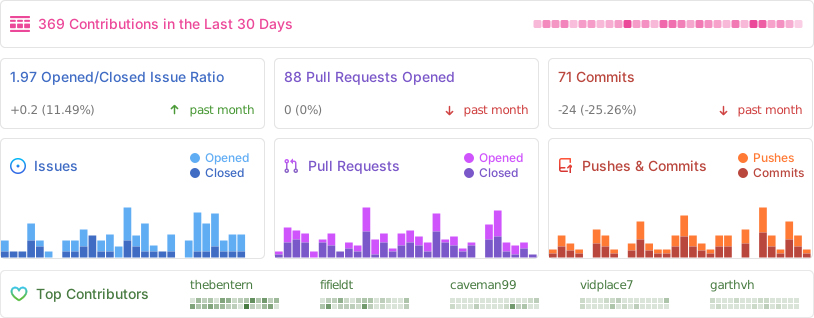
Stats