Ben Meadors
01d1873bfc
Ben Meadors
01d1873bfc
* Deliver locally-generated replies addressed to us to the phone

Config get/set from the phone times out on every device: the client sends an
admin request, the node handles it, and the response is silently dropped
before it reaches the phone queue.

#10967 changed Router::sendLocal's isToUs branch from enqueueReceivedMessage()
to handleReceived(p, src), so a local packet keeps its RxSource instead of
being relabeled RX_SRC_RADIO by the queue round-trip. That is the right call
for the new policy gates, but module replies go out through
MeshService::sendToMesh() with the default RX_SRC_LOCAL, and a reply to a
phone-originated request is addressed to our own node (setReplyTo resolves
from == 0 to ourNodeNum). Those replies now re-enter callModules as
RX_SRC_LOCAL, where the loopback gate skips every module whose loopbackOk is
false - including RoutingModule, whose promiscuous sniff is the only path that
moves a received packet into toPhoneQueue. The reply is released, never sent.

Requests still work, because the phone's own packets arrive as RX_SRC_USER and
pass the gate, so a set_config is applied and only its acknowledgement is lost.
That is why a client can connect and download config but times out on every
config screen and every setter.

Deliver the phone's copy from sendToMesh() instead: for a local packet
addressed to us, the loopback gate is doing its job in keeping the packet away
from module re-dispatch, and the phone copy is exactly what is missing. Setting
loopbackOk on RoutingModule would instead echo every locally-generated
broadcast back to the phone, and relabeling replies RX_SRC_RADIO would undo the
origin separation #10967 added.

Also stop reporting ERRNO_SHOULD_RELEASE (35) to the phone in the QueueStatus
for these packets. It means "caller frees", not a send failure, and the same
hunk changed it from the 0 the phone used to see.

* Address review: trim comments, assert the QueueStatus count

Condense the added comments to the one-or-two-line house style; the rationale
lives in the commit message and PR.

The reply test drained QueueStatus records in a while loop, which would have
passed just as happily on an empty queue. Count them and require both the
request's and the reply's.

Meshtastic Firmware




Overview
This repository contains the official device firmware for Meshtastic, an open-source LoRa mesh networking project designed for long-range, low-power communication without relying on internet or cellular infrastructure. The firmware supports various hardware platforms, including ESP32, nRF52, RP2040/RP2350, and Linux-based devices.
Meshtastic enables text messaging, location sharing, and telemetry over a decentralized mesh network, making it ideal for outdoor adventures, emergency preparedness, and remote operations.
Get Started
- 🔧 Building Instructions - Learn how to compile the firmware from source.
- ⚡ Flashing Instructions - Install or update the firmware on your device.
Join our community and help improve Meshtastic! 🚀
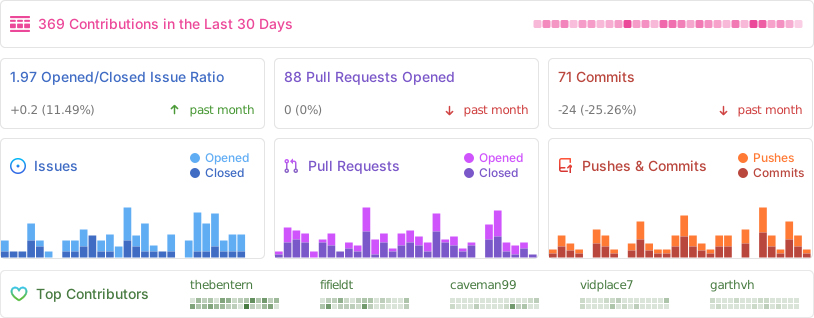
Stats